
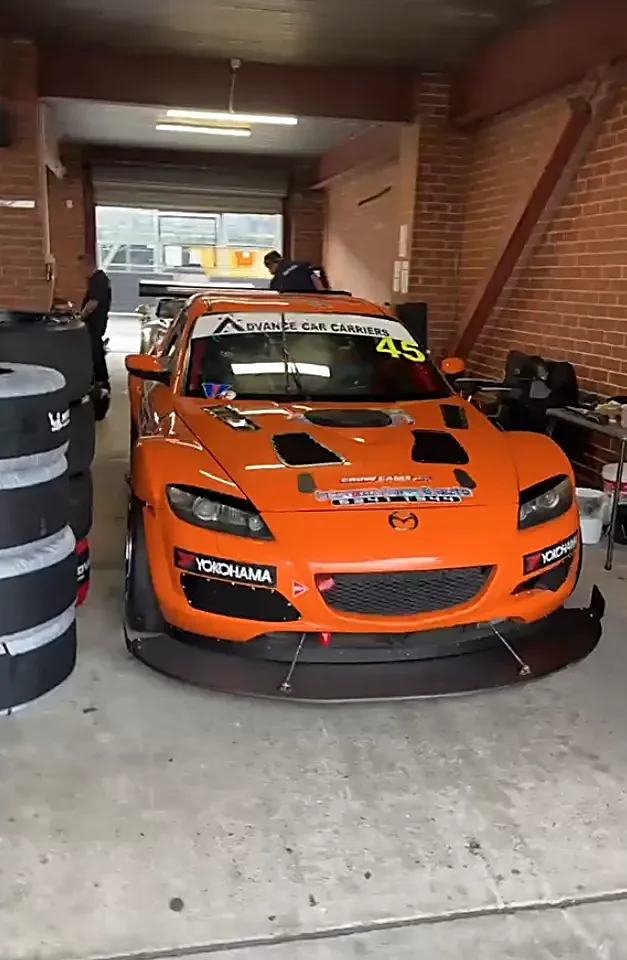
Mazda RX-8 LS V8 Speedway — 553 hp
An LS V8-swapped RX-8 speedway car taken from 469 to 553 hp on Haltech Nexus — through a custom cam, oil-pressure control and race-throttle calibration.
What the project set out to do
Calibrate a Mazda RX-8 speedway car that had been engine-swapped with a freshly built 6.0L LS-based V8 and purpose-built for competition, on Haltech Nexus Rebel LS management — for repeatable power and, just as importantly, reliability under sustained racing load.
The engineering problem
The engine was a fresh, high-output build: 14:1 compression pistons, ported cylinder heads, aftermarket extractors and camshaft — the latter a 238°/254° grind at 0.050" with 0.609" lift on 108°/116° centrelines (112° lobe-separation angle). A 14:1 naturally aspirated race engine leaves no margin for a calibration or lubrication error.
The Haltech Nexus Rebel LS was set up with full health monitoring — oil pressure, oil temperature, fuel pressure and wideband lambda. After the initial calibration the engine made 469 hp, but the oil-pressure behaviour was not satisfactory, and that had to be understood before the car could be trusted at race pace.
Two more limits surfaced as the work went on: the original induction was choking the engine, and the aftermarket camshaft it had been built with was not specified for the car's intended operating range. A third issue only appeared at the track.
How it was calibrated
Oil pressure came first. On a high-compression race engine it is never read as a single number — it is mapped against both engine RPM and oil temperature, so the real lubrication picture can be seen and a developing problem caught before it becomes a failure. That analysis framed every decision that followed.
The induction was then rebuilt to a single-plane intake manifold with quad 40 mm throttle bodies. The original setup proved to be a significant airflow restriction — output rose to 538 hp once it was removed.
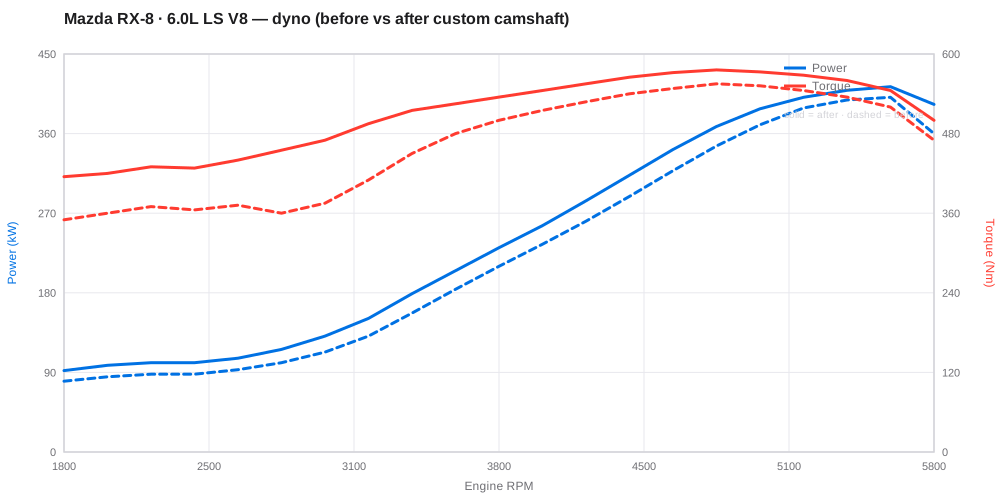
With the airflow freed up, the camshaft was the next limit. A custom profile was specified for the engine's range and application — 242°/258° at 0.050", 0.630" lift, on 106°/110° centrelines with a 108° LSA. The result was immediate: roughly +50 Nm through the low and mid range and around +25 Nm across the rest, with peak power up to 553 hp — the green-to-red step on the dyno graph.
Then the track taught its own lesson. At a race event the data showed the driver's pedal was only commanding about 70% throttle, even though the throttle body reached 100% on the workshop dyno — a throttle-control setup issue no bench test had revealed.
The result
The car ended up at 553 hp with substantially more usable torque everywhere it matters on a speedway, on a calibration backed by proper oil-pressure analysis and corrected throttle control. The bigger outcomes were the methods: lubrication mapped against RPM and temperature so reliability is engineered rather than hoped for, and the discipline of validating against real race data — because the workshop cannot reproduce every mechanical, environmental and human factor of a race weekend. It is usually the small details, refined, that decide both performance and survival.
Oil pressure is a relationship, not a number
On a high-compression, naturally aspirated race engine under sustained load, oil pressure should never be viewed in isolation. It has to be mapped and evaluated against engine RPM and oil temperature together — those relationships are what reveal engine health and let a lubrication problem be identified before it turns into a catastrophic failure. It is the single analysis I cannot emphasise enough.
Why workshop testing alone isn't enough
The throttle reached 100% on the dyno but only about 70% from the driver's pedal at the track — a discrepancy only real data logging under race conditions exposed. Simulating real operating conditions is critical: bench testing cannot always replicate the mechanical, environmental and human factors of competition, and it is often the refinement of seemingly minor details that ultimately determines overall performance and reliability.
Questions about this project
Why specify a custom camshaft instead of an off-the-shelf grind?
The engine's as-built aftermarket cam wasn't matched to its intended operating range and application. A profile cut for that range (242°/258° at 0.050", 0.630" lift, 106°/110° centrelines, 108° LSA) added roughly 50 Nm in the low and mid range and lifted peak power to 553 hp.
How was the oil-pressure concern handled?
By mapping oil pressure against both RPM and oil temperature rather than reading it in isolation — the only way to see the real lubrication picture on a 14:1 race engine and catch a problem before it becomes a failure.
Why did the throttle only reach 70% on track?
Workshop testing showed 100% throttle-body opening, but race data logs revealed the pedal was only commanding about 70% — a throttle-control setup issue that only appeared under real race conditions. It is why validating against real data matters.
The engineering behind your workshop's calibrations
This kind of project is shared to show the depth behind the day-to-day work. Approved workshops calibrate directly with the same engineer. It is not a service sold to the public.
