
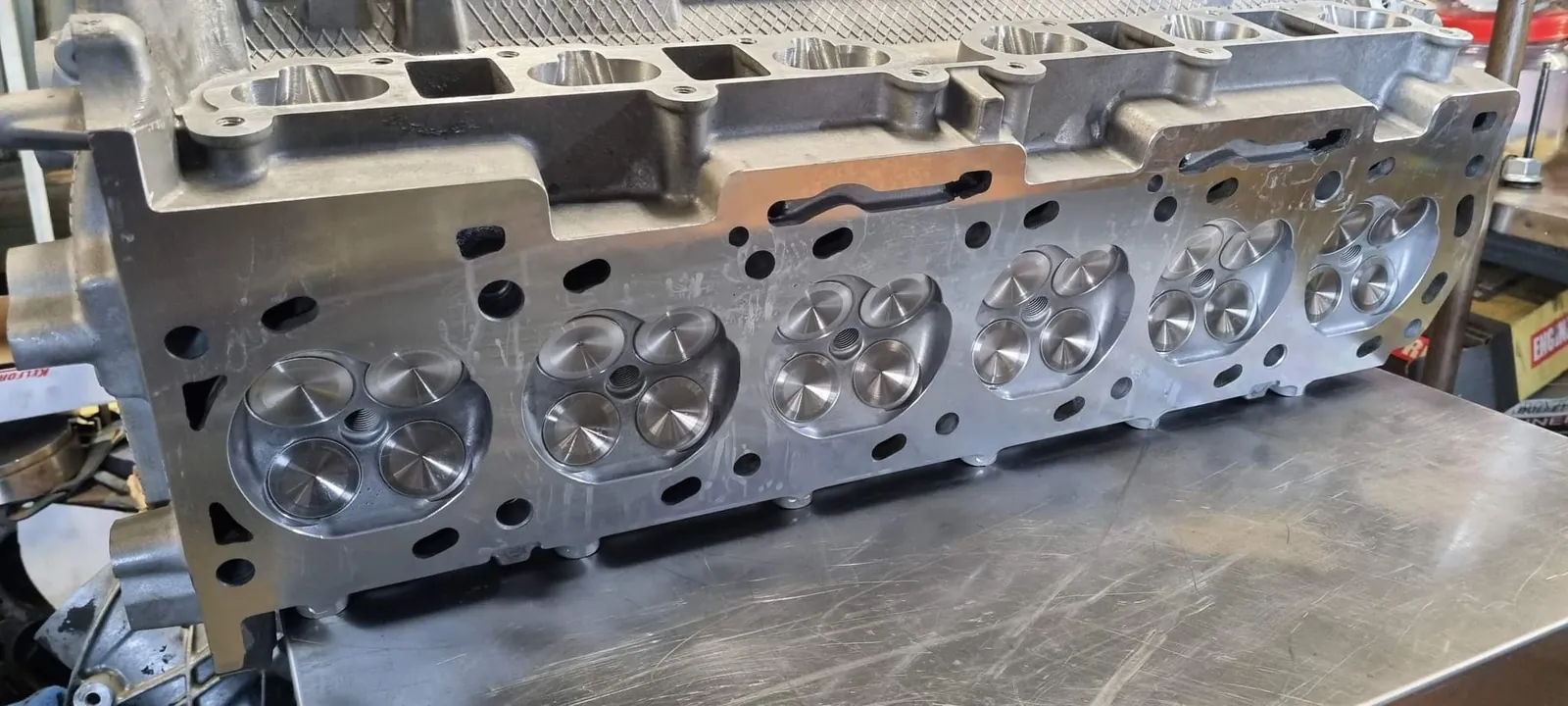
Inlet Manifold Port Matching
You can spend real money porting a cylinder head and then hand all of it back at the last joint before the cylinder. Where the intake manifold meets the head, air either flows through a clean, continuous path or it trips over a step it never sees coming. Port matching is the small, unglamorous job that protects everything upstream of it.
What Inlet Manifold Port Matching Is
Inlet manifold port matching is the work of aligning and blending the intake manifold runners to the cylinder head ports so air crosses the joint without hitting a sudden change in size or shape. The manifold and head are made by different processes, often by different manufacturers, and they almost never line up perfectly. Where they disagree, the air slows, separates and turns turbulent — and turbulent air right at the port entry is air that does not make it into the cylinder. Matching restores continuity: one smooth path from the runner to the valve. It is not about making everything bigger. It is about removing the step.
The detail that decides whether it helps or hurts
Direction is everything. Air stepping down from a slightly larger manifold into a smaller head is tolerable. Air running into a wall because the head is bigger than the manifold — a backward step — is a genuine flow killer. Match in the right direction or you can make it worse.
Why a Mismatched Joint Costs You Cylinder Filling
Air has mass and momentum. It does not stop and re-read the map at every junction — it carries on in a straight line until a wall makes it turn. A mismatch at the manifold joint is exactly the kind of wall it cannot follow.
The backward step
The head port is larger than the manifold runner, so air arrives and meets a step facing back at it. The flow separates off that edge, a turbulent dead zone forms right at the port mouth, and effective area is lost exactly where it matters most. This is the worst case — and the most common.
The forward step
The manifold is larger than the head. Air steps down into the smaller port. Not ideal, but far gentler — the flow stays attached and simply accelerates. If you must have a mismatch, this is the direction to have it in.
The offset
Even when the sizes match, the runner and port can be offset sideways or rotated, so one wall has a step while the other is recessed. Air does not flow down the middle — it follows walls. A sideways offset disrupts flow just like a size mismatch.
Cross-Sectional Area, Airspeed and the Smooth Path
The same velocity-first thinking that governs head porting applies at the joint. The aim is a continuous cross-sectional area that changes — if it changes at all — gradually, so airspeed is preserved and the boundary layer stays attached to the wall.
- Cross-sectional area transitions should be gradual. A smooth taper over length keeps the air attached; a sharp local change trips it.
- Airspeed preservation matters more than maximum size. A matched joint that holds velocity beats a hogged-out one that lets the air go slack.
- Boundary layer management — a clean, continuous wall keeps the slow-moving film thin and the fast core intact across the joint.
- Runner taper theory — many intake runners are deliberately tapered to accelerate air toward the valve. A blunt match can flatten that taper and waste it.
- Reversion control — at certain points in the cycle, pressure pushes air back out of the cylinder. A clean joint and the right runner length keep that reversion from disrupting the next charge.
Don't blindly grind to the gasket
The intake gasket is a sealing part, not a flow template. "Match both sides to the gasket" is the advice that creates over-sized, velocity-dead ports. Match the parts to each other, in the right direction, and only as much as the mismatch requires.
Done right, port matching is a conservative job: you are removing a defect, not redesigning the port. Most of the benefit comes from fixing the backward step and the offset — both of which you can have for the cost of careful measurement and a light, correct cut.
The Intake Is a Tuned Pipe, Not Just a Path
Air in an intake tract does not flow as a steady stream — it pulses, once per intake event, and those pulses set up pressure waves that travel up and down the runner. Get the timing right and a high-pressure wave arrives at the valve just before it closes, packing in extra charge for free. This is where runner length and volume earn their keep.
Intake runner resonance
Each runner has a length that resonates strongest at a particular RPM. Tune it for low RPM and you get a fat midrange; tune it short for high RPM and you trade that midrange for top-end. Runner length is a powerband decision, and port matching should respect the runner the designer gave you rather than blunt it.
Helmholtz effects
The plenum and runners behave like a Helmholtz resonator — the same physics as blowing across a bottle. The plenum volume and runner geometry together set a resonant frequency that, when it lines up with valve events, boosts cylinder filling. A messy joint adds loss that damps the very resonance you want.
Pressure recovery at the entry
A clean, gently-transitioning joint lets the air convert velocity back into pressure smoothly as it enters the port — pressure recovery — instead of dumping that energy into turbulence at a step. It is the same principle that makes a tapered port out-flow a bigger straight one: shape beats size.
Joint Conditions Compared
Four ways the manifold-to-head joint can end up, and what each does to the air.
| Joint condition | What the air meets | Effect on flow | Verdict |
|---|---|---|---|
| Matched & aligned | One continuous wall, gradual change | Velocity preserved, no separation, even distribution | The target |
| Forward step (manifold larger) | Air steps down into the smaller port | Flow stays attached and accelerates — minor loss | Tolerable |
| Backward step (head larger) | A wall facing back at the incoming air | Separation, dead zone and lost area at the port mouth | Fix this |
| Both over-matched to gasket | Oversized, velocity-dead runner and port | Lost airspeed, weak midrange, poor reversion control | Avoid |
How It's Done Properly
Locate the parts as they actually assemble
Dowel or accurately locate the manifold to the head. The match has to reflect how the parts bolt together under load, not where a gasket happens to sit in free air. Get this wrong and you can "match" a joint into a worse offset than you started with.
Measure the mismatch and its direction
Find where the runner and port disagree, by how much, and which side is larger on each wall. The direction of the step decides everything about what you do next.
Correct in the right direction
Open the upstream manifold side to meet the head, or accept a slight downstream step — never leave the head larger than the manifold. The rule is simple: the air should never run into a wall facing back at it.
Blend a smooth taper, not a local cut
Carry any correction back into the runner as a gentle taper so airspeed is preserved and the flow stays attached. A sharp local grind solves the step and creates a new disturbance behind it.
Make every runner consistent
Cylinder-to-cylinder distribution depends on every joint being the same. One runner matched beautifully and three left rough gives you an engine that fuels and knocks differently on every cylinder — a calibration headache. Consistency beats perfection on a single port.
What Matching Buys You
Consistent airflow
One continuous path means the air behaves the same way every cycle — fewer surprises for the calibration.
Less turbulence
Removing the step removes the dead zone at the port mouth, so more of the runner area actually flows.
Even cylinder distribution
Consistent joints give consistent filling cylinder-to-cylinder — the foundation of a stable tune.
Higher VE
Less loss at the joint means more air per stroke at the same throttle and RPM — straight to volumetric efficiency.
Sharper throttle response
Preserved airspeed and clean transitions make the engine answer the pedal more crisply, especially off-idle.
More predictable tuning
An even, continuous intake gives a calibration that holds its trims and timing — fewer per-cylinder corrections to chase.
Inlet Manifold Port Matching — FAQ
What is manifold port matching?
Aligning and blending the intake manifold runners to the cylinder head ports so air crosses the joint without hitting a step or offset. The goal is a single continuous path from runner to valve, which preserves airspeed and keeps the flow attached to the wall.
Does port matching increase power?
It can, mainly by recovering airflow you were losing to a backward step or an offset at the joint — which shows up as better cylinder filling and steadier cylinder-to-cylinder distribution. The gain is usually broad and driveable rather than a big peak number, and it makes the calibration more predictable.
Can oversized ports hurt performance?
Yes. Grinding both sides out to the gasket is the classic mistake — it kills the airspeed that fills the cylinder and flattens the midrange. Bigger is not the goal; continuous and correctly-directed is. Match only as much as the mismatch requires.
Is port matching useful for turbocharged engines?
Yes. Boost does not excuse a bad joint — every loss still has to be paid for with drive pressure and heat. A clean intake transition helps the charge enter the cylinder cleanly and keeps cylinder-to-cylinder distribution even, which matters even more when each cylinder is being asked to do a lot.
Tell us what the intake actually is.
Ported head, matched manifold, a different plenum or runner length — it all changes the air the engine sees. When you submit a file, describe the intake so the calibration is built on the real airflow, not the factory assumption.
