
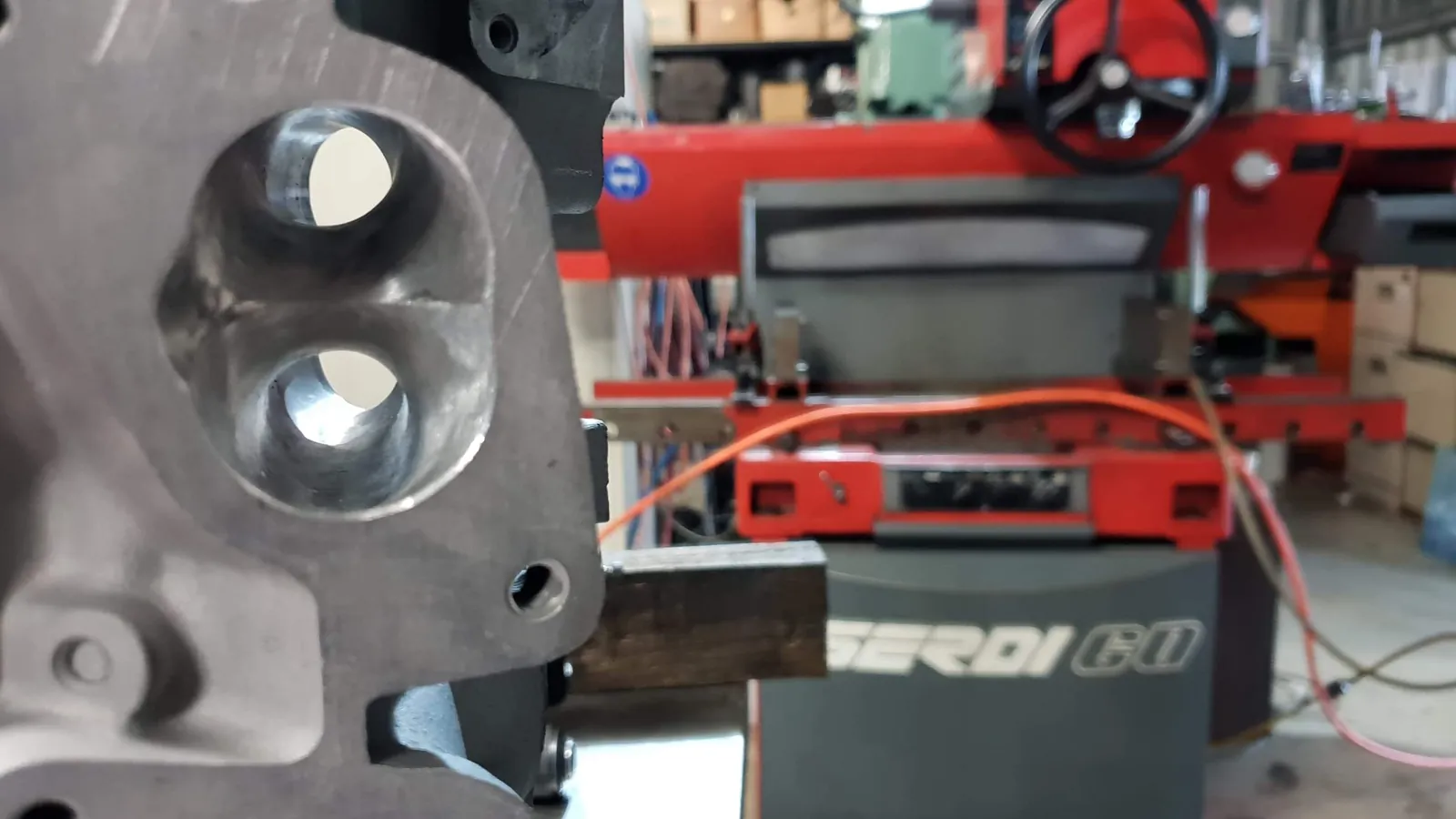
Cylinder Head Porting & Airflow Optimisation
An engine is an air pump. Everything you do to make more power is, underneath, an attempt to move more air through the cylinder head — cleanly, quickly, and at the right moment. Porting is how you do that. Done well it is one of the highest-value modifications on the engine. Done badly it makes a head that flows big numbers on the bench and less torque than stock on the road.
What Cylinder Head Porting Actually Does
Cylinder head porting is the reshaping of the intake and exhaust ports, the bowls under the valves, the valve seats and the combustion chamber to improve how air flows into and out of the cylinder. The goal is not a bigger hole. The goal is more useful airflow — more air delivered per intake stroke (higher volumetric efficiency) without throwing away the port velocity that actually fills the cylinder. A good port flows more air and keeps it moving fast. Get both and you get more torque across the range, a happier turbo, and a calibration that has something real to work with. Chase flow alone and you can easily end up slower.
The one sentence to remember
Velocity fills a cylinder; volume is what the brochure measures. The art of porting is adding flow without killing speed — and most of that happens at the valve job and short-side radius, not in the middle of the port where it is easy to grind.
Airflow Sets the Ceiling — Everything Else Works Beneath It
Torque is the engine's response to how completely you fill the cylinder with air and fuel, burn it, and push on the piston. That chain has a name at every link, and porting works on the first and most important one.
Volumetric Efficiency
How much air actually enters the cylinder versus how much it could hold at atmospheric conditions. A naturally-aspirated engine rarely hits 100% across the range. The head is usually what is holding VE back at high RPM.
BMEP
Brake mean effective pressure — the average pressure pushing on the piston over a cycle. It is the cleanest single measure of how hard the engine is working per litre, and it tracks VE and combustion quality directly.
Torque
BMEP multiplied by displacement, near enough. Fill the cylinder better at a given RPM and you raise BMEP at that RPM — which is torque at that RPM. Torque is the thing you actually feel.
Power
Torque multiplied by RPM. Power is what happens when you can hold good torque to a higher RPM — which means flowing enough air up top without losing the velocity that made torque down low.
Read that chain backwards and the lesson is blunt: you do not "make power", you make airflow, and power is the receipt. The calibration — fuelling, ignition timing, boost targets — can only spend the airflow the hardware delivers. That is why we treat the head as part of the tune, not a separate job. If you want to see how the finished article reads on the dyno, the dyno results shows verified before/after results.
Velocity vs Volume — Why a Bigger Port Is Not a Better Port
This is the misconception that costs the most money. A port has a cross-sectional area (CSA). Open that area up and, at a given engine speed, the air moving through it slows down — same volume, bigger pipe, lower speed. Lose too much speed and you lose the two things that quietly do most of the cylinder-filling work.
Inertia (ram) charging
Fast-moving air has momentum. As the piston slows at the bottom of the stroke and the valve starts to close, a high-velocity column keeps packing air into the cylinder for a few crank degrees longer. That free supercharging effect is proportional to velocity. Oversize the port and you trade it away — the engine goes flat in the midrange and never gets it back.
Mixture motion
Velocity is what generates the swirl and tumble that mixes fuel and air and gives a fast, complete burn. A slow, lazy port produces a slow, lazy flame — worse combustion, more timing required, more knock sensitivity. The fastest-burning chambers are usually the ones still moving air with intent at the valve.
The number tuners actually target
Head developers size a port to a target mean gas velocity at peak power, not to a flow number. As a rough industry guide, a street/road port lives healthiest when peak-power mean velocity sits in the order of ~0.5 of the speed of sound through the smallest part of the port; push much past that and the port chokes, drop far below it and you have thrown away velocity for a bench number nobody drives on. The exact figure depends on the engine — but the principle is fixed: size the port for the velocity you want, then make it flow as much as it can at that size.
There is a hard limit waiting at the other end, too. Open a valve and air has to squeeze through the ring-shaped gap between the valve face and the seat — the valve curtain area (roughly the valve diameter times lift times pi). At low lift that curtain is the smallest hole in the whole system, and no amount of grinding in the middle of the port changes it. This is the choke point: find the true restriction, fix that, and ignore the parts that already flow. Polishing a port wall that was never the limit is how a head ends up shinier and slower.
The Unglamorous Parts That Make the Difference
Ask where the gains live and the honest answer is: in the three places that do not photograph well. The middle of the port — the part everyone wants to open up — is rarely the problem.
The short-side radius
The tight inside corner where the port turns down toward the valve. Air does not like turning sharp corners at speed — it separates from the wall, the flow detaches, and a chunk of your port area stops working. Reshaping this radius so the air can follow the turn is often the single biggest gain available, and it is the hardest to do by hand.
The valve job
A multi-angle seat blended into the bowl controls flow at the low and mid lift where the engine spends almost all of its time. The valve job is the most important porting you will ever pay for and the least photogenic. A great valve job on an otherwise standard port will out-perform a hogged-out port with a single 45° seat — every time.
The combustion chamber
Unshrouding the valve, tidying the chamber walls and managing the quench area improve both flow off the seat and how the mixture burns. A good chamber lets you run the ignition timing the engine wants without it rattling. This is where airflow work and calibration meet.
Boundary Layers, Separation and Pressure Recovery
You do not need a wind-tunnel vocabulary to port a head well, but the four ideas below are what is actually happening inside that grey casting. They also explain why "smooth and shiny" is not the goal.
Boundary layer
A thin film of slow-moving air clings to the port wall. It is unavoidable, and a mirror polish does almost nothing to reduce it — which is why serious intake ports are left with a deliberate matte or lightly textured finish rather than a chrome shine. A slightly textured wall can actually keep the faster air attached better than a polish.
Flow separation
When the wall turns away faster than the air can follow — that short-side corner again — the flow detaches and leaves a dead, turbulent pocket that blocks part of the port. Most "bad" ports are not too small; they are separating. Fixing separation recovers area you already had.
Swirl & tumble
Organised in-cylinder motion — swirl (rotation around the bore axis) and tumble (rotation across it). The right amount, for that engine, gives a fast, repeatable burn. Too little and combustion is slow and knock-prone; too much and you choke flow chasing mixing you did not need. It is a balance, not a maximum.
Pressure recovery
A well-shaped port lets the air speed up through the throat and then slow back down smoothly, converting velocity back into pressure as it enters the cylinder — instead of losing that energy to turbulence. Good pressure recovery is why a port with a gentle taper out-flows a port that is simply bigger.
Street Porting vs Race Porting — Different Goals, Different Shapes
There is no "best" port. There is the right port for the powerband you need, the fuel and boost you are running, and the camshaft it has to work with. A drag head and a circuit head are shaped differently on purpose.
| Approach | What it focuses on | Effect on CSA / velocity | Powerband it suits | Trade-off |
|---|---|---|---|---|
| Clean-up & valve job | Fix casting flash, blend the bowl, cut a proper multi-angle seat | CSA essentially unchanged; velocity preserved | Everywhere — broad, streetable gains | Low risk, high value |
| Street port | Short-side & bowl work, modest throat opening, kept velocity-first | Small CSA increase; velocity still strong | Low-end and midrange torque, daily driveability | Best all-round choice |
| Race port (high RPM) | Larger CSA for peak flow, matched to a big cam and high RPM | Larger CSA; velocity drops at low RPM by design | Top-end power for engines that live at high RPM | Soft below the powerband |
| Over-ported | Maximised bench flow with no velocity target | CSA too big; velocity collapses | Looks good on a flow sheet, drives worse than stock | The expensive mistake |
The pattern is consistent: the safe money is in the valve job and short-side work, and the risk climbs the moment CSA is opened up without a velocity target to justify it.
How a Head Is Actually Developed
Porting is measurement first and grinding second. The order matters — every step after the first is a response to what the previous step told you. Guessing with a die grinder is how you turn a good casting into scrap.
Baseline flow test
Flow the head as it sits across the whole lift range. You want to know where it flows, how fast the air is moving to get there, and the lift at which it stops gaining. That last point tells you whether the head or the cam is the limit.
Find the real restriction
Almost always the throat, the seat, and the short-side radius — not the part of the port that is easiest to reach. Confirm it on the bench rather than assuming it. The biggest gain is hiding behind the hardest cut.
Bowl and short-side work
Reshape the bowl under the valve and the short-side radius so the air can turn the corner and stay attached to the wall. Re-flow after, not at the end — you are looking for the flow to keep climbing at higher lift instead of plateauing early.
Cut the valve job
A blended multi-angle seat that flows hard at low and mid lift, where the engine spends its life. This is the step that most reliably moves the dyno number, and it is precision machine work, not freehand grinding.
Finalise the cross-section
Only now do you decide how much, if any, the port body needs opening — sized to the target mean gas velocity for the engine's peak-power RPM. Enough for the top end, never so much that you bleed away the velocity that made midrange torque.
Re-test and match to the cam & tune
Confirm the gain is real across the working lift range, then match the head to the camshaft and hand the airflow to the calibration. A head and a cam developed together beat two good parts chosen separately. See the camshaft selection guide for how those two decisions interlock.
What Good Head Work Buys You
When porting is done airflow-first instead of size-first, the benefits show up everywhere — not just as a bigger peak number.
More efficient airflow
More air delivered per stroke at the same valve lift — higher VE without leaning on the cam to do all the work.
Better cylinder filling
Fuller, more even cylinder filling across the range and between cylinders, which steadies the calibration.
More torque, sooner
Velocity-first porting lifts the whole torque curve, not just the peak — the part you feel on the road.
Happier turbocharger
A free-flowing head lets a given turbo reach target boost sooner and hold it with less drive pressure.
Lower pumping losses
Less work spent dragging air past restrictions means more of the fuel's energy reaches the crank.
Cleaner combustion
The right mixture motion burns faster and more completely — more usable timing, less knock sensitivity.
Does Porting Help a Turbo Engine? Yes — Differently
People assume a turbo can "just push more air through a bad port". It can — but it pays for the privilege. Every restriction in the head has to be overcome with drive pressure, which means more exhaust backpressure, more heat, more reversion, and a turbo working harder than it should to hit the same boost.
Open the head up properly and the same boost arrives earlier, with a better pressure ratio across the turbine, lower intake air temperature, and more knock margin for the calibration to spend on timing. On a boosted engine, head work often shows up as a response and efficiency gain as much as a peak-power one — and it is the exhaust side that frequently matters most.
- Target boost reached at lower RPM — better spool and response
- Lower exhaust manifold pressure for a given boost — less reversion
- Cooler charge into the cylinder — more timing the tune can actually use
- More knock margin for the calibrator to convert into safe power
- Less turbo working temperature for the same output — longevity
The exhaust-side story has its own page — exhaust & extractor port matching.
Cylinder Head Porting — FAQ
Does porting increase horsepower?
Yes, when it raises real airflow across the lift range the engine uses — and the calibration is updated to suit. Porting that only chases bench flow without a velocity target can add a peak number while losing torque where you drive. Power follows useful airflow, not polish.
Does a bigger port always make more power?
No. This is the most expensive misconception in head work. Past the point that suits the engine, a bigger port slows the air down, kills inertia charging and mixture motion, and makes the engine flat in the midrange. Bigger is not better — bigger is just bigger.
Is porting beneficial on turbo engines?
Yes, often more so. A free-flowing head lets a turbo reach and hold boost with less drive pressure, lower exhaust backpressure and cooler charge temps — which gives the calibration more timing and knock margin to work with. On boost it is frequently the exhaust side that matters most.
How much power can cylinder head porting add?
It depends entirely on how restrictive the casting was and what else changes with it. A good valve job and clean-up on a restrictive head can be a meaningful, broad gain; a full race port matched to a cam and a higher RPM ceiling can be much more. Anyone quoting a fixed percentage without seeing the head and the combination is guessing.
Does porting require a camshaft upgrade?
Not always, but the two are linked. A head and cam developed together beat two good parts chosen apart. If the head now flows to a higher lift, a cam that opens the valve further and longer lets you use it. Clean-up and a valve job stand alone fine; an aggressive race port really wants a matching cam. See the camshaft guide.
Can factory cylinder heads be improved?
Almost always. Production heads are cast to a budget and a tooling compromise, with casting flash, a basic valve seat and a short-side radius shaped for manufacturability rather than flow. There is usually real, low-risk airflow sitting in a factory head waiting for a proper valve job and bowl blend.
If You Remember Five Things
Airflow is the ceiling
VE → BMEP → torque → power. You make airflow; power is the receipt.
Velocity fills cylinders
Don't trade away the speed that gives you inertia charging and mixture motion.
Fix the choke point
Throat, seat and short-side radius — not the easy middle of the port.
The valve job wins
The least photogenic work delivers the most reliable gain. Pay for it.
Match head, cam & tune
Develop them together. The calibration can only spend the airflow you build.
Building a head? Bring the airflow story to the calibration.
When you submit a file, tell us what the head is — clean-up, street port, or full race port — along with the cam and the target RPM. The calibration is built around the air the hardware actually moves.
