
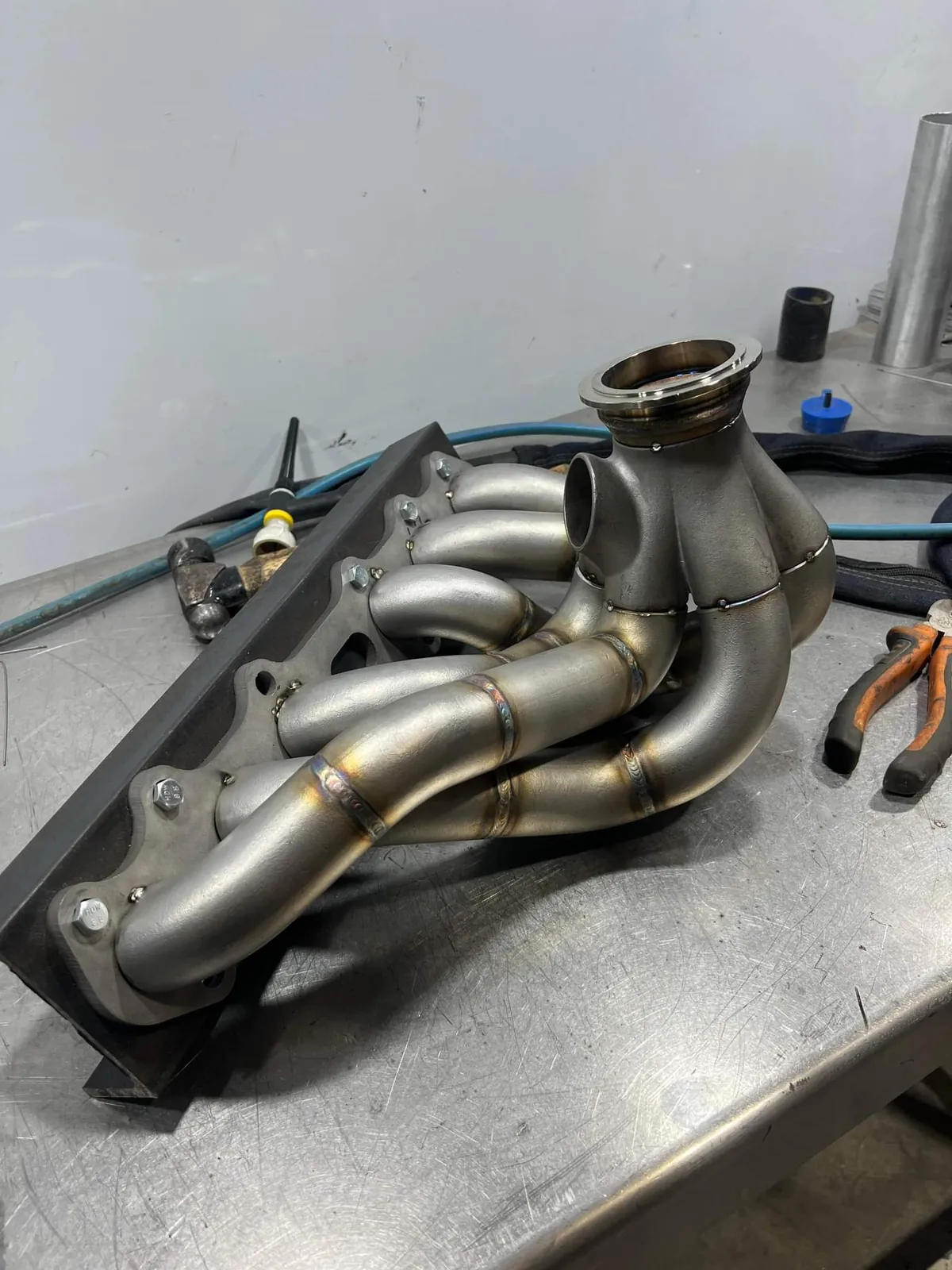
Exhaust & Extractor Port Matching
Half of making power is getting the spent charge out of the way so the next one can come in. The exhaust side is not just a drain — it is a tuned system that, done right, actively helps pull the cylinder empty and, on a turbo, delivers the energy that spins the turbine. Match it badly and you choke the engine on its own exhaust.
What Exhaust Port Matching Is
Exhaust port matching is aligning and blending the exhaust manifold or extractor primaries to the cylinder head exhaust ports so spent gas leaves cleanly, without tripping over a step at the joint. Like the intake side, the goal is continuity and preserved velocity — but the reason is different. On the exhaust side, fast-moving gas does useful work: it scavenges the cylinder, using its own momentum and pressure pulses to help drag out residual gas and even start pulling the fresh intake charge in. On a turbo engine, that same velocity and pulse energy is what drives the turbine. Lose it to a sloppy joint and you lose scavenging, response and efficiency at once.
The myth to drop first
"Engines need some backpressure" is one of the most stubborn pieces of bad folklore in tuning. Engines do not want backpressure. What they want is exhaust velocity and correctly-timed pulses. The reason a too-big exhaust can lose low-end is lost velocity — not "not enough backpressure".
Scavenging — The Exhaust That Helps Fill the Cylinder
During valve overlap — the brief window when both the exhaust and intake valves are open — a fast, low-pressure exhaust stream can reach back and help pull the fresh charge in behind it. That is scavenging, and it is free cylinder filling that depends entirely on exhaust velocity and pulse timing.
Cylinder evacuation
The more completely you clear burnt gas out of the cylinder, the more room there is for fresh charge — and the less hot residual is left to heat the next mixture and promote knock. Good evacuation is both a power and a knock-margin gain.
Exhaust velocity
A primary sized to keep gas moving fast carries the scavenging pulse with authority. Over-size it and the gas goes slack, the pulse weakens, and the cylinder is left to empty on piston push alone. Velocity is the currency of the exhaust side, just as it is on the intake.
Reversion reduction
A clean joint and correct sizing stop exhaust gas washing back into the cylinder and port during overlap. Reversion contaminates the fresh charge and upsets the tune; controlling it is a big part of why matching the exhaust side is worth doing.
Backpressure Is Not the Goal — Velocity Is
The folklore goes: "if you fit a bigger exhaust you lose low-end torque, therefore engines need backpressure." The observation is real; the explanation is wrong. What you lost was not helpful backpressure — it was exhaust velocity. A pipe that is too big for the engine's airflow lets the gas slow down, which weakens scavenging in the midrange where you felt the loss.
Backpressure is pure loss — it is pressure the engine has to push against on every exhaust stroke, a direct pumping loss. The right exhaust has the least backpressure it can while holding the velocity the engine needs for scavenging. Those two goals are balanced by correct sizing, not by deliberately adding restriction.
Where it really bites: turbo engines
On a turbo engine, backpressure upstream of the turbine — exhaust manifold pressure — is the enemy. When it climbs above intake boost pressure, the engine fights reversion, runs hot, and the calibration has to pull timing. A clean, matched exhaust port and manifold keep that pressure down and the pulse energy intact.
This is the same lesson as the intake side and the head: shape and velocity beat size. Bigger is only better up to the point that the gas stays fast.
Pulse Tuning, Collectors and Exhaust Energy
Each exhaust event sends a pressure pulse down the primary. Manage those pulses well and they help each other; manage them badly and they collide, reverting into cylinders that are still on overlap. This is what extractor and manifold design is really about.
Pulse tuning
Primary length and diameter set when a cylinder's exhaust pulse arrives at the collector and how it interacts with its neighbours. Tuned right, a departing pulse creates a low-pressure wave that helps the next cylinder scavenge. This is why primary length is a powerband decision, not just a packaging one.
Collector design
Where the primaries merge, the collector blends the pulses and sets how much each cylinder benefits from its neighbours' scavenging. A good collector keeps velocity up through the merge; a blunt one dumps it. The port match feeds clean gas into this whole tuned system.
Turbine drive energy
On a turbo engine the exhaust is not thrown away — its pressure and heat energy spin the turbine. A matched port and manifold deliver sharp, high-energy pulses to the turbine wheel, which is what gives crisp spool and response. A stepped, leaky joint smears the pulse and softens the turbo.
Pumping losses
Every bit of restriction the piston has to push exhaust through is work stolen from the crank. Smooth, correctly-sized, well-matched exhaust paths lower that pumping loss — efficiency you keep across the whole map, not just at peak.
Exhaust Joint Conditions Compared
| Joint condition | What happens to the gas | Effect | Verdict |
|---|---|---|---|
| Matched, slight step out | Gas exits into a marginally larger primary, stays fast | Strong scavenging, sharp pulses, clean turbine drive | The target |
| Pipe smaller than port | Exit throttled at the joint | Restriction, higher manifold pressure, lost flow | Fix this |
| Backward step into cylinder | A wall facing the cylinder during overlap | Reversion, contaminated charge, hot residual | Worst case |
| Over-sized port & primary | Gas slows down through the joint | Weak scavenging, soft midrange, lazy spool | Velocity lost |
How It's Done
Mock up as assembled
Fit the manifold or extractor to the head with the correct gasket and fasteners so the match reflects the real, bolted-up position — exhaust parts move and seal differently to intake ones.
Match in the right direction
Allow a small step from the head out into a slightly larger primary, so gas accelerates as it leaves. Never leave the pipe smaller than the port — that throttles the exit and traps gas in the cylinder.
Preserve velocity
Resist the urge to open everything up. Exhaust velocity is what scavenges the cylinder and feeds the turbine. Size for the engine's airflow, not for the biggest pipe that fits.
Keep every runner consistent
Match all ports equally so each cylinder scavenges the same — and on a turbo, so every pulse reaches the turbine with the same energy. Uneven exhaust joints give uneven exhaust gas temperatures and a tune that never settles.
What Matching the Exhaust Side Buys You
Improved scavenging
Preserved velocity and clean pulses pull the cylinder empty and help draw the next charge in during overlap.
Sharper turbo response
High-energy pulses delivered cleanly to the turbine give crisper spool and quicker boost recovery.
Lower pumping losses
Less restriction on every exhaust stroke means more of the combustion energy reaches the crankshaft.
Better cylinder evacuation
More complete clearing of burnt gas leaves room for fresh charge and less hot residual to provoke knock.
Less reversion
A clean, correctly-directed joint stops exhaust washing back into the port and contaminating the intake charge.
Better overall efficiency
Lower exhaust manifold pressure and cleaner evacuation give the calibration more timing and knock margin to use.
Exhaust Port Matching — FAQ
Does exhaust port matching increase power?
It can, by recovering scavenging and lowering exhaust restriction that a stepped or mismatched joint was costing you. On a naturally-aspirated engine the gain shows up as better cylinder evacuation and midrange; on a turbo engine it shows up as response and lower manifold pressure. As always, it works because it preserves velocity, not because it makes the hole bigger.
Can larger exhaust ports reduce torque?
Yes. Over-size the exhaust port or primary and the gas slows down, scavenging weakens, and you lose midrange torque — the same effect that gave rise to the "engines need backpressure" myth. What the engine actually lost was velocity. Size the exhaust to keep gas moving fast, not to be as big as possible.
Is port matching beneficial for turbo vehicles?
Very. On a turbo engine the exhaust energy drives the turbine, so delivering sharp, high-energy pulses through a clean, matched joint directly improves spool and response. It also keeps exhaust manifold pressure down, which reduces reversion and gives the calibration more knock margin. The exhaust side is often where boosted engines gain the most.
What is exhaust scavenging?
Scavenging is the use of fast-moving exhaust gas and its pressure pulses to help empty the cylinder of burnt gas and, during valve overlap, to start drawing the fresh intake charge in behind it. It is effectively free cylinder filling — and it depends entirely on exhaust velocity and pulse timing, which a good port match protects.
Boosted or NA, the exhaust shapes the tune.
Extractors, a matched turbo manifold, primary sizing — they change scavenging, manifold pressure and spool. When you submit a file, tell us the exhaust setup so the calibration is built around the gas the engine actually moves.
