
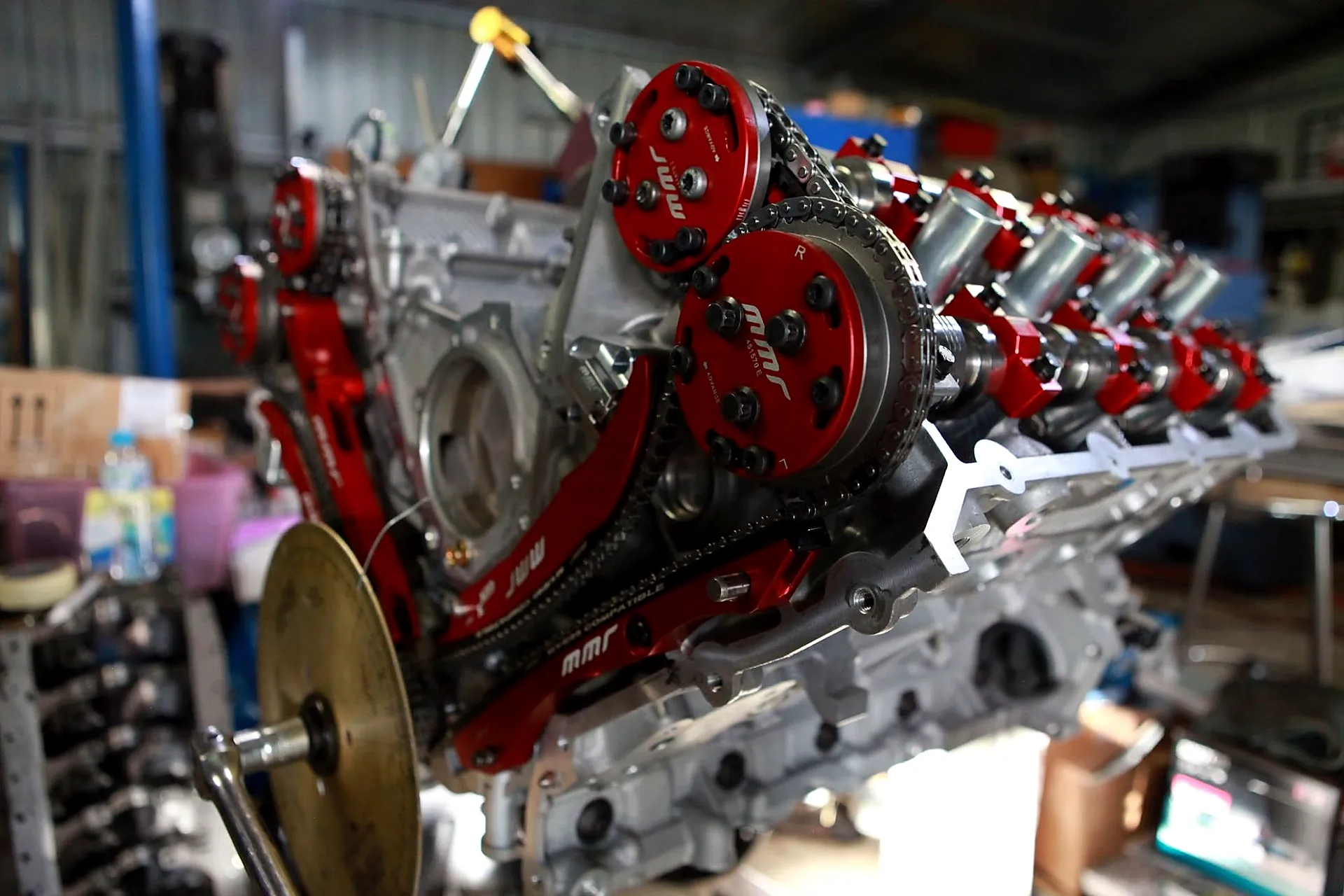
Camshaft Selection & Variable Cam Timing
The camshaft defines the engine's entire character — its torque spread, idle quality, RPM range, and emissions behaviour. Get it wrong and no amount of calibration can recover what the hardware cost you.
The camshaft sets the engine's whole character — torque spread, idle quality and RPM range — so it has to be matched to the build, then dialled to its specified lobe-centre angles with a degree wheel before any tuning. A cam a few degrees out, or one too large for the application (over-cammed), cannot be corrected in calibration. Where the engine has variable cam timing, keeping and tuning it preserves the mid-range torque the factory engineered in.
Dialling the Cam In — Not Optional
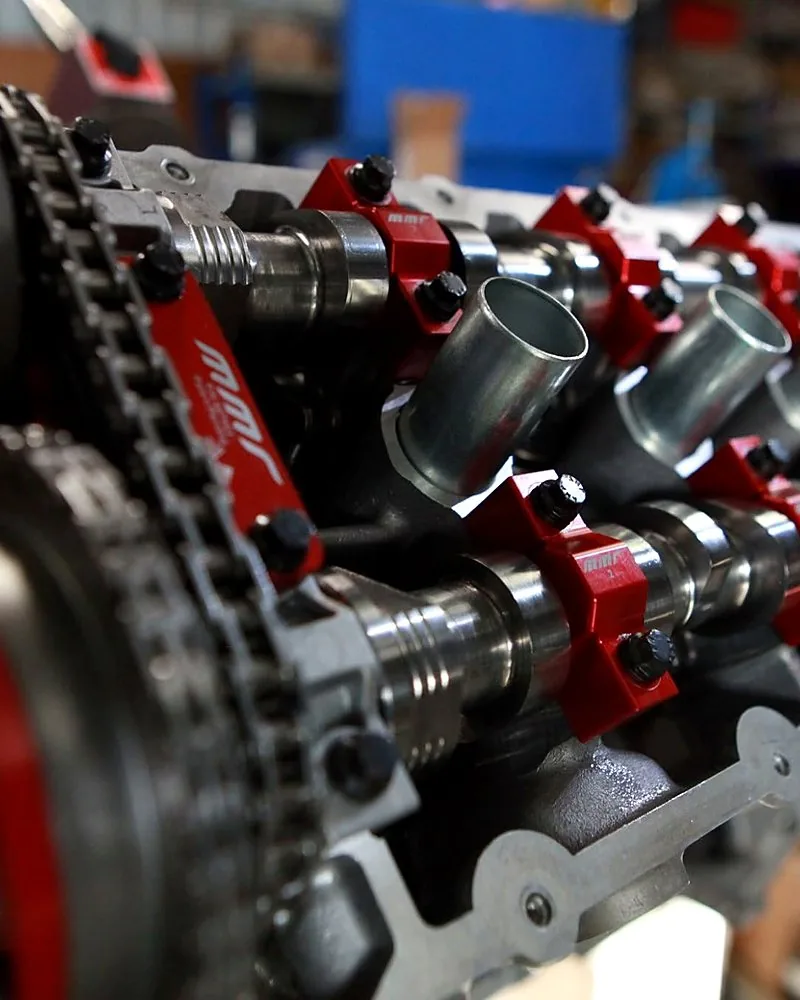
Fitting a performance camshaft and relying on the factory timing marks to confirm it is correctly installed is a mistake. Timing marks are a manufacturing tolerance reference — not a precision measurement. A cam that is four degrees out from its specified lobe centre angle will not perform as designed, and you cannot calibrate around it.
Establish accurate TDC
Use a piston stop or a degree wheel referenced against a fixed pointer. Do not trust the factory TDC mark without verification — they can be off by one to three degrees on a worn or reused timing cover.
Mount a dial indicator on the valve
Position the dial indicator directly on the valve retainer or lifter. The indicator must be parallel to the valve stem axis — any angle introduces cosine error into every reading.
Find maximum lift and the lobe centre
Rotate the engine and record the degree reading at which each lobe reaches peak lift. The lobe centre angle is the crankshaft degree at which this occurs. Compare it to the cam card specification.
Verify both intake and exhaust
Both lobes need to be checked and recorded. Confirm the lobe separation angle (LSA) matches spec. An incorrect LSA means the overlap window is wrong — which directly affects scavenging efficiency and idle quality.
Advance or retard intentionally if required
Once you know where the cam actually sits, you can make an informed decision to advance (move torque peak down in RPM) or retard (shift power higher) using an offset key or adjustable cam gear. This is an application decision — not a guessing game with timing marks.
A cam that is not dialled in is not tunable
If the lobe centres are not verified and set correctly, the calibration is being built on a faulty baseline. You cannot recover the lost torque or power through tuning — the timing relationship between the cam and the crank determines when the cylinder fills and when it exhausts. That is mechanical, not electrical.
The Three Variables — and Why Application Comes First
Every camshaft is defined by three fundamental numbers: duration, lift, and lobe separation angle. Changing any one of them moves the engine's operating range, its breathing efficiency at specific RPM, its idle behaviour, and its emissions profile. The mistake most workshops make is selecting a cam around a peak power number rather than around the application the vehicle will actually live in.
Duration
How long the valve stays open, expressed in crankshaft degrees. More duration raises the RPM at which the engine breathes most efficiently. A cam with 280+ degrees of duration on a street engine that spends its life between 1500 and 4000 RPM is delivering nothing useful in that range and actively hurting cylinder pressure and low-end response.
Lift
How far the valve opens. Higher lift increases airflow up to the point where the port flow becomes the limiting factor. Lift beyond the port's flow capacity at that area gains nothing. Head flow bench data and cylinder head specification determine where that ceiling is — not general horsepower folklore.
Lobe Separation Angle
The angle between the intake and exhaust lobe centres. Tighter LSA increases overlap, scavenging efficiency, and top-end power — at the cost of idle quality and low-RPM cylinder pressure. Wider LSA cleans up the idle and helps low-end torque but reduces peak output. Every street vehicle is a compromise. Every race vehicle is a targeted decision.
Application-first cam selection
- Street performance: shorter duration, moderate lift, wider LSA — torque in the usable RPM range, clean idle, driveable
- Circuit race: moderate-to-long duration, high lift, tighter LSA — broad power band, efficient scavenging across the lap
- Drag: longer duration, high lift, tighter LSA — peak power is the primary objective
- Diesel tow: cam timing that supports maximum torque and cylinder pressure at low RPM and high load
Common selection mistakes
- Choosing a cam based on another workshop's peak power figure without knowing their RPM range, header, intake, or compression
- Fitting a race-spec cam in a street vehicle because the duration number is impressive
- Not accounting for the installed compression ratio — cam selection is inseparable from compression
- Selecting cam timing without considering what the calibration can and cannot compensate for
Bigger Is Not Always More — This Is Extremely Common
Over-camming is one of the most persistent and widespread mistakes in performance engine building. It is driven almost entirely by marketing duration numbers and misapplied advice. A cam that is too aggressive for an application does not produce more power in the RPM range the vehicle actually uses — it reduces it. And no calibration can give back what the cam takes away.
What over-camming actually does to a street engine
Excessive duration reduces cylinder pressure at low RPM because the intake valve is still open well past the point where the piston would otherwise trap the charge. This blows the mixture back out of the cylinder. The result: poor idle quality, loss of vacuum (affecting brakes, map sensors, and emissions systems), reduced low-to-mid range torque, increased fuel consumption, and a vehicle that makes impressive peak power numbers on a dyno at 6500 RPM but is genuinely slow on the road where it lives between 1500 and 4000.
Real-World Performance Impact
An over-cammed street engine typically shows a large torque deficit from idle to the cam's powerband RPM — often 1500 to 3500 RPM where most street driving occurs. The vehicle feels flat off the bottom, requires higher RPM to feel responsive, and rarely delivers the driving experience the builder expected. The peak power figure on the dyno sheet looked impressive. The vehicle is disappointing to drive.
The Calibration Cannot Fix It
Attempts to recover low-end torque through ignition advance, fuel enrichment, or idle strategy when the cam has eliminated the cylinder filling efficiency in that range achieve very little. You can optimise within the cam's operating window. You cannot extend the window through calibration. If the cam is wrong for the application, the cam needs to change.
VCT and VVT — The Most Underutilised Tool in the Workshop
Variable cam timing systems (VCT, VVT, AVCS, MIVEC — the name varies by manufacturer) allow the ECU to continuously position the camshaft across a range — typically 20 to 50 crankshaft degrees — depending on engine speed, load, and temperature. This is the closest thing to a camshaft that changes its specification on demand. When properly calibrated, it provides more low-end torque AND more peak power than a fixed cam of equivalent duration. It is routinely bypassed, locked out, or ignored.
What It Does at Low RPM
At light throttle and low RPM, the system retards or holds the cam in a position that minimises overlap — improving idle stability, reducing reversion, and supporting low-end cylinder pressure. The engine behaves like a mild-duration camshaft at this end of the range.
What It Does at High RPM
Under high load and RPM, the system advances the cam to maximise the overlap window and improve scavenging efficiency. The engine effectively runs a more aggressive cam profile where it benefits from it — at peak load, high speed — without the idle and low-end penalty of that profile at all other times.
Locking It Out Loses Both Ends
A fixed cam can only optimise for one operating condition. Locking VCT to a single position — whether advanced or retarded — forces a compromise at every other operating point. The most common reason given for disabling VCT is "simplicity". What it actually trades is broad torque and driveability for a fixable problem that deserved proper investigation instead.
The cam and the VCT calibration must be developed together
If you install an aftermarket camshaft in an engine with a variable timing system, the VCT control maps need to be updated to reflect the new lobe geometry. The OEM VCT tables were developed for the OEM cam profile. Running a performance cam with OEM VCT calibration means the system is positioning the cam based on the wrong reference — you may be getting some benefit, but you are almost certainly leaving mid-range torque and part-throttle response on the table. Submit the full engine specification when you bring a VCT-equipped build to calibration.
What Correct Cam Timing and VCT Calibration Actually Delivers
The chart below illustrates the torque difference between a baseline run and an optimised calibration on the same engine with variable cam timing correctly developed. The highlighted zone between 2000 and 3500 RPM represents the gain — where the vehicle is driven the vast majority of the time.
This is not a peak power story. The gain between 2000 and 3500 RPM is where the vehicle is driven — acceleration from low speed, highway overtaking, load management on a tow vehicle. A 150 Nm improvement in that band changes the driving character of the vehicle more than an equivalent peak power gain at 6500 RPM that most drivers never reach.
What to Provide When You Submit a Cam Build for Calibration
- Cam card from the manufacturer — grind number, duration at 0.050", lobe lift, and specified lobe centre angles
- Confirmed installed lobe centre angles from your dial exercise — not assumed from timing marks
- Whether the cam was installed straight up, advanced, or retarded — and by how many degrees
- VCT/VVT system status — operational, locked, or removed. If locked, at what cam position
- Head specification — ported, stock, valve size, spring installed height and seat pressure
- Compression ratio — static and dynamic (dynamic is what actually matters with this cam)
- Intended RPM operating range and vehicle application
If VCT is operational, tell us the range
Provide the cam advance range available on the platform — whether that is from the OEM specification or measured. The calibration tables for VCT control are built around the available authority. A system that physically moves 40 degrees needs different tables than one with 20 degrees of authority, even on the same base cam grind.
Do not disable VCT unless you have a specific reason
"The solenoid was faulty" is a reason. "Someone told me to lock it out" is not. If the variable timing system is functional, leave it operational and calibrate it properly. The performance benefit is real and consistent.
Building a cam-spec engine?
Submit the full engine specification through the dealer portal and we'll develop the calibration around the actual hardware — VCT, head flow, compression, and application together.
