
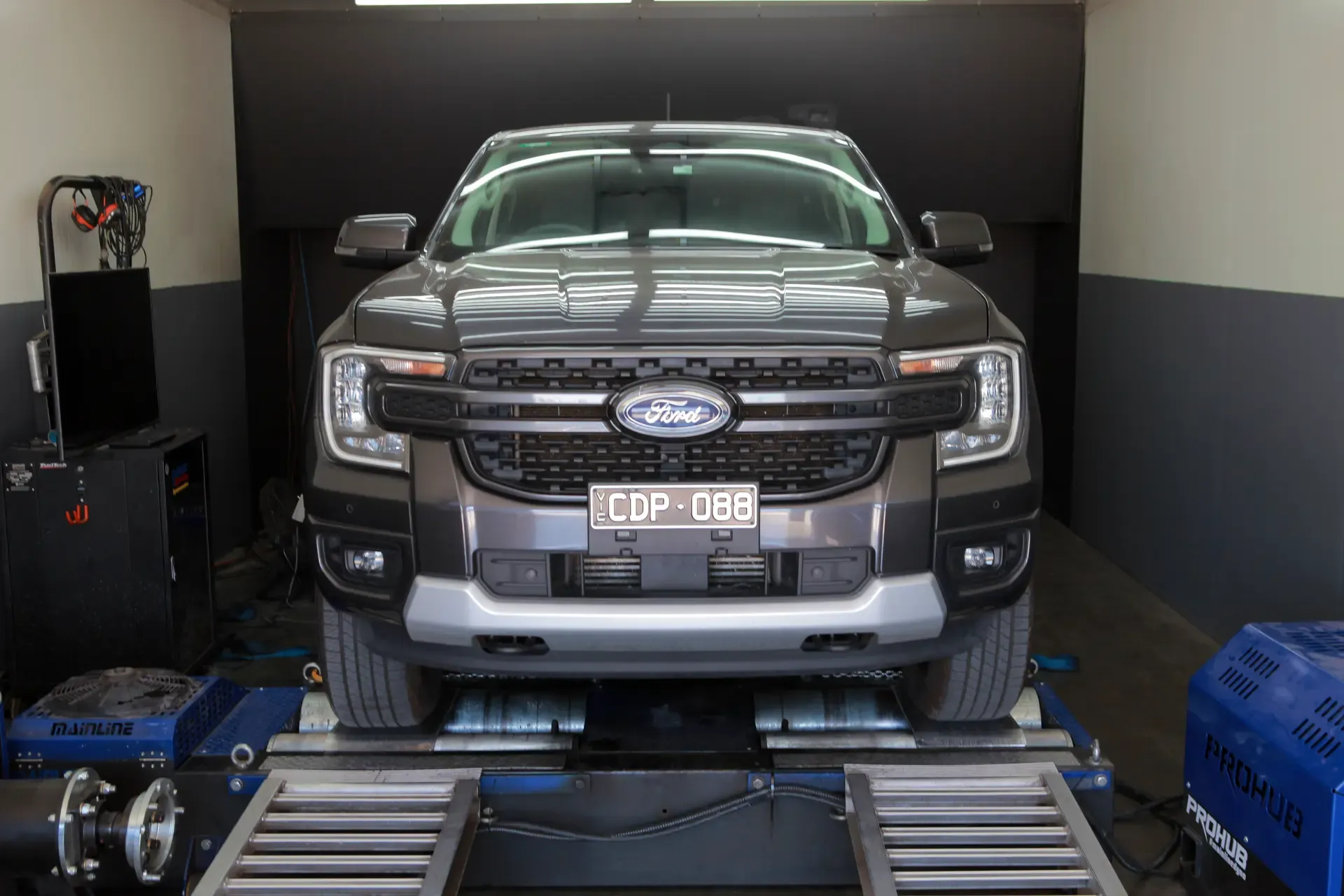
Ford Ranger Raptor 3.0 V6 EcoBoost Tuning & Calibration
The 3.0-litre twin-turbo EcoBoost V6 is what makes the current Ranger Raptor a petrol performance ute — 292kW and 583Nm from the factory, and genuinely responsive to a properly developed calibration.
Ford Ranger Raptor 3.0L V6 Twin-Turbo EcoBoost Petrol
The Ford Ranger Raptor's 3.0L twin-turbo EcoBoost V6 (292kW / 583Nm) is calibrated on PCMTec or HP Tuners, focused on twin-turbo boost control, fuelling headroom, knock control and the 10-speed automatic. Every file is developed from the stock read and validated against logged boost, fuel pressure and knock before sign-off.
What the Ford Ranger Raptor 3.0 V6 EcoBoost needs from a calibration
The 3.0-litre EcoBoost — the twin-turbo petrol V6 in the current Ranger Raptor — makes 292kW and 583Nm as delivered, and is the petrol alternative to the diesel utes rather than a variant of them. It is a boosted engine with real headroom, and it responds hard to a calibration developed on its own data.
Boost and fuelling are the core work. The two turbochargers are calibrated to deliver a clean, held boost curve rather than a peak the engine gives back, and fuelling is set to its real limit and verified on logged fuel pressure. Knock control is proven on logged data rather than assumed — on a boosted petrol six that is the difference between a strong tune and an expensive one.
The 10-speed automatic behind it is the other half of the job: torque limits and shift behaviour calibrated so the box holds the added torque and shifts cleanly instead of hunting. The Raptor's anti-lag strategy also has to be respected rather than worked around. Treated as one system and validated on logs, the 3.0 EcoBoost makes a strong, streetable step.
What the work concentrates on
Twin-turbo boost control
The two turbos calibrated to deliver a clean, held boost curve across the range, matched to the hardware fitted.
DI + port fuelling
Direct-injection fuelling calibrated to its real headroom with port injection brought in where fitted, verified on logged fuel pressure.
10-speed auto tuning
Torque limits and shift behaviour calibrated so the 10-speed holds the added torque and shifts cleanly through its ratios.
Knock control
Timing verified against logged knock so the calibration is safe and repeatable on the fuel the vehicle runs.
Where the Ford Ranger Raptor 3.0 V6 EcoBoost catches workshops out
Boost not holding target
The factory curve backs off. Boost is re-based near target and trimmed on logged target-vs-actual for a clean, held curve within the hardware's range.
Fuel pressure at high output
High-output maps stress direct injection. Fuelling is calibrated to real headroom and confirmed on logged fuel pressure, with port injection carrying the rest.
10-speed shift behaviour
The many-ratio auto is calibrated with the engine so it holds the added torque and shifts cleanly instead of hunting.
Symptom → cause → calibration logic for the issues above:
More in the calibration problem library.
Ford Ranger Raptor 3.0 V6 EcoBoost calibration — questions workshops ask
What do you tune the Raptor 3.0 EcoBoost on?
PCMTec or HP Tuners — both give the boost, fuel and 10-speed transmission access the EcoBoost needs, with deep logging for validation. We match the approach to the build.
Is the Ranger Raptor a 3.5 EcoBoost?
No. The current Ranger Raptor runs the 3.0L twin-turbo EcoBoost V6 (292kW / 583Nm). The 3.5 EcoBoost is the F-150's engine — a different calibration platform. Earlier overseas Raptors were also offered with the 2.0 bi-turbo diesel.
Do you tune the 10-speed automatic too?
Yes — torque limits and shift behaviour are calibrated with the engine so the box holds the added torque and shifts cleanly through its ratios.
Can it run E85?
Where the build supports it, ethanol fuelling can be calibrated and verified on logged AFR and fuel pressure. We advise on fuel-system headroom for your specific setup.
Does the vehicle need to come to you?
No. Your workshop reads the ECU and logs the vehicle; we develop and validate the EcoBoost calibration from your data. You keep the customer relationship.
Calibrate a Ford Ranger Raptor 3.0 V6 EcoBoost with us behind you
Your workshop reads the ECU and logs the car; we develop and validate the calibration from your data. See real Ford results in the Ford dyno results. Calibrations are for off-road and competition use; accounts are manually reviewed.
